
Share:
AI has become one of the fastest-adopted technologies in marketing history. Global AI adoption in marketing has climbed from 29% in 2021 to 76% in 2026, while 91% of marketing teams now use AI to support their daily work.
The global AI marketing market, valued at $20.4 billion in 2024, is projected to reach $107.5 billion by 2028. Organizations using AI strategically report 44% productivity gains, 22% higher campaign ROI, and marketers save an average of 6.1 hours every week by automating repetitive work.
This report gathers verified data from 100+ trusted sources into a single, up-to-date reference. It covers adoption rates, market size, ROI benchmarks, generative AI, Personalization, AI search, chatbots, consumer sentiment, challenges, and the trends reshaping marketing in 2026.
Top AI Marketing Statistics for 2026
Here are the most important AI marketing figures shaping adoption, budgets, productivity, and strategy in 2026.
Sources: IBM, HubSpot, Salesforce, McKinsey, Grand View Research, Duke CMO Survey, Jasper
Adoption by Company Size
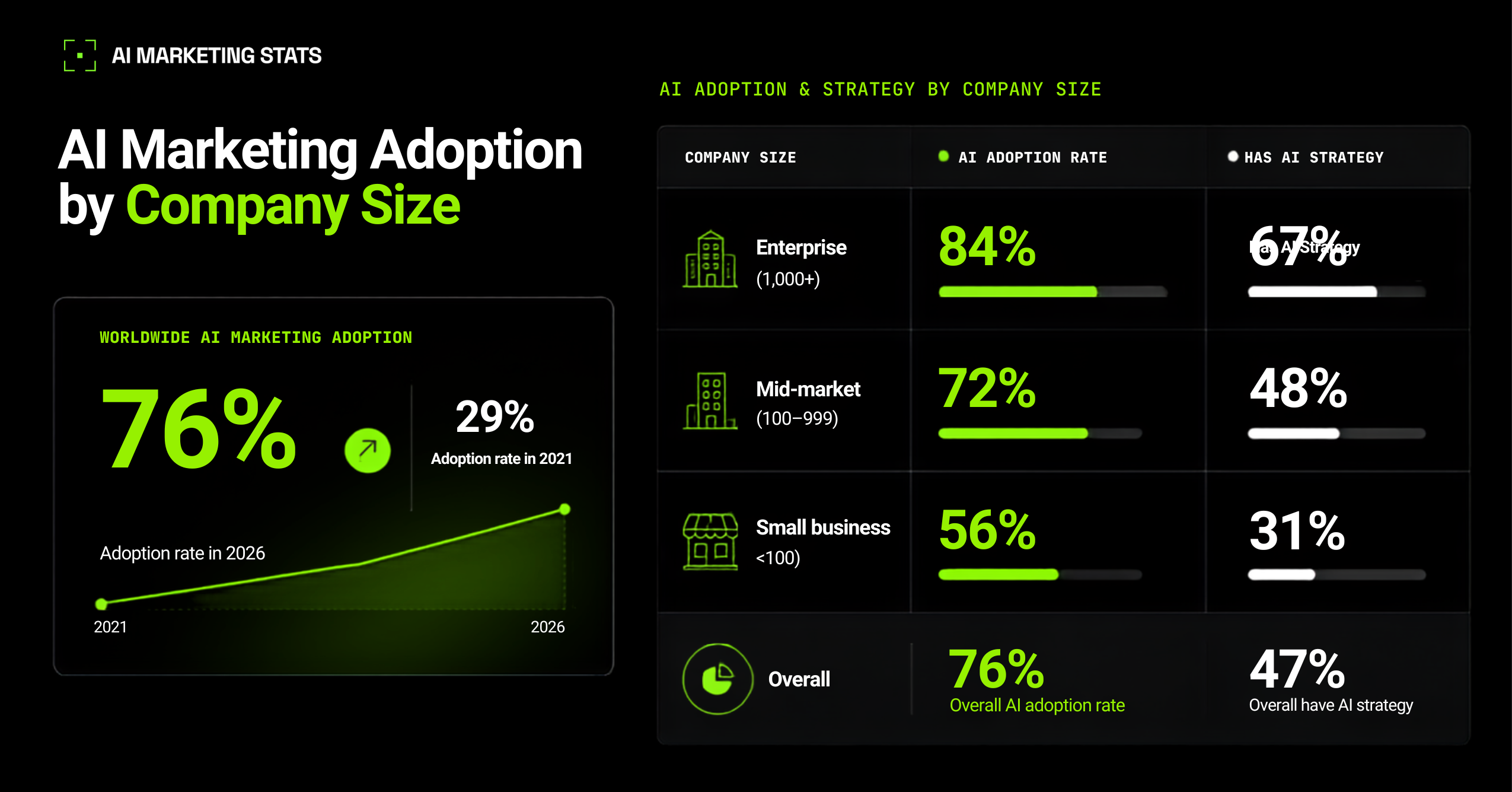
| Company Size | AI Adoption Rate | Has AI Strategy |
|---|---|---|
| Enterprise (1,000+) | 84% | 67% |
| Mid-market (100-999) | 72% | 48% |
| Small business (<100) | 56% | 31% |
| Overall | 76% | 47% |
Sources: HubSpot, IBM, McKinsey, Salesforce, Duke CMO Survey, Ascend2, Gartner
Deployment by Marketing Use Case
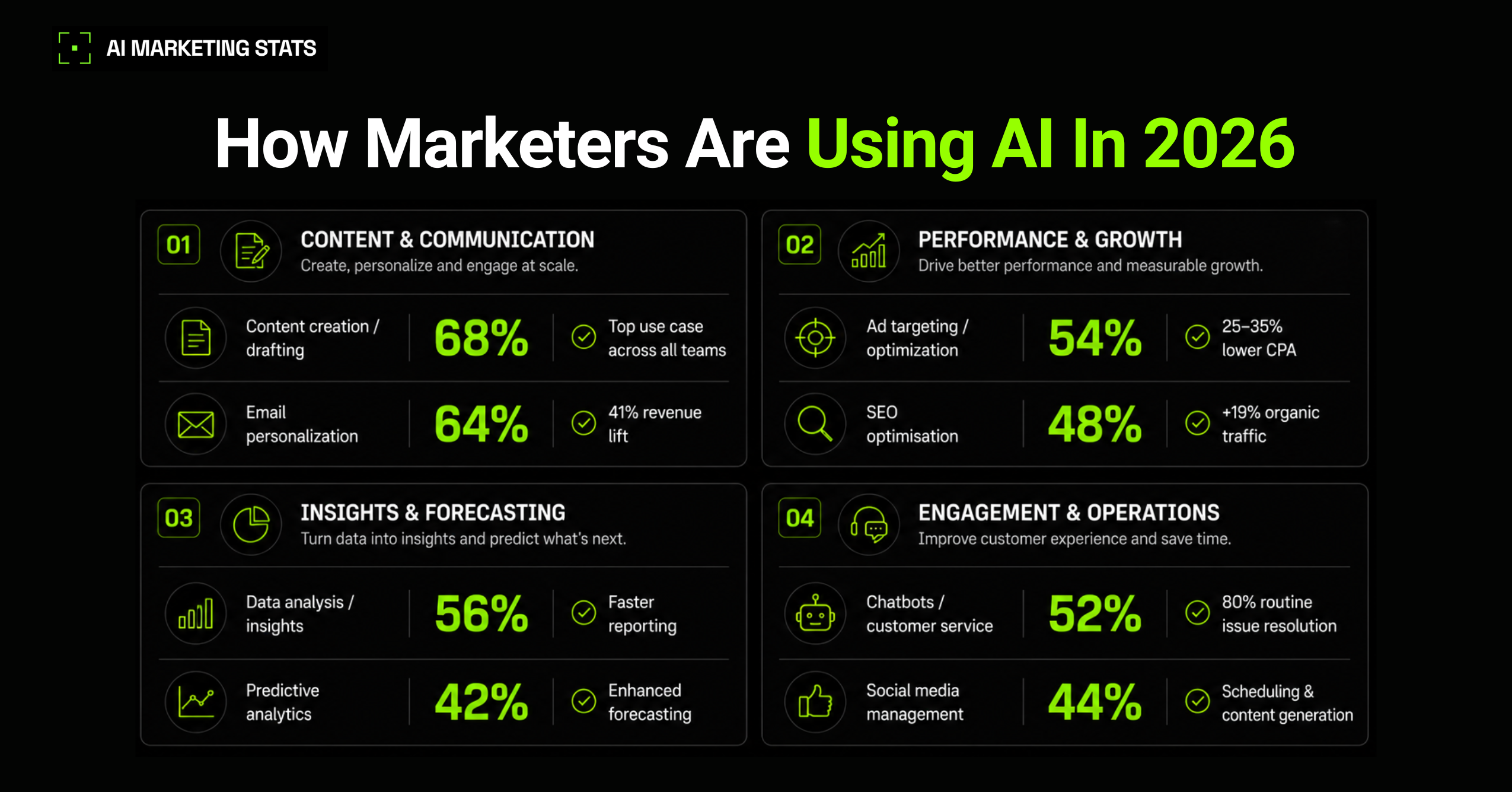
| Use Case | Adoption Rate | Primary Benefit |
| Content creation/drafting | 68% | Top use case across all teams |
| Email Personalization | 64% | 41% revenue lift |
| Data analysis/insights | 56% | Faster reporting |
| Ad targeting/optimization | 54% | 25-35% lower CPA |
| Chatbots/customer service | 52% | 80% routine issue resolution |
| SEO optimisation | 48% | +19% organic traffic |
| Social media management | 44% | Scheduling and content generation |
| Predictive analytics | 42% | Enhanced forecasting |
Sources: HubSpot, Salesforce, McKinsey
AI Marketing Market Size Statistics
The AI-in-marketing market has experienced explosive growth driven by generative AI adoption, increased enterprise investment, and the expansion of AI-powered advertising platforms. Market size estimates vary across research firms due to differing scoping methodologies, but all major analysts agree on strong double-digit growth exceeding 24% CAGR.
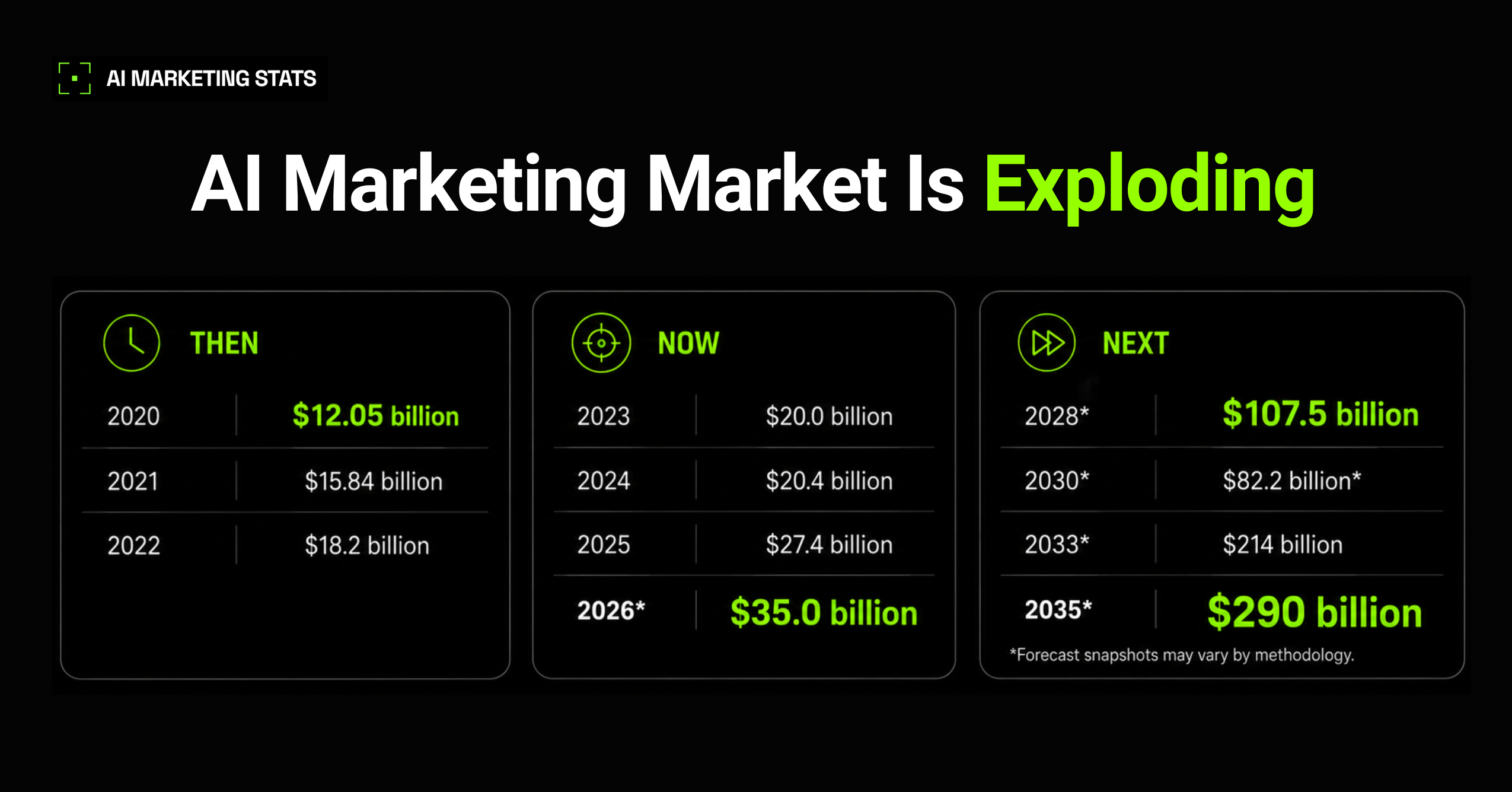
Market Size Over the Years
| Year | Market Size (USD) |
| 2020 | $12.05 billion |
| 2021 | $15.84 billion |
| 2022 | $18.2 billion |
| 2023 | $20.0 billion |
| 2024 | $20.4 billion |
| 2025 | $27.4 billion |
| 2026* | $35.0 billion |
| 2028* | $107.5 billion |
| 2030* | $82.2 billion* |
| 2033* | $214 billion |
| 2035* | $290 billion |
*Market size estimates vary significantly across firms due to differing scoping methodologies (narrow AI marketing platforms vs. broad AI-powered advertising ecosystem).
Sources: Grand View Research, Statista, SNS Insider
Market Growth by Region
| Region | Share of Global Market (2024) | Projected CAGR (2025-2030) |
| North America | 32.4% | 24-26% |
| Europe | 24-27% | 23-25% |
| Asia Pacific | 22-26% | 26-28% |
| Latin America | 5-7% | 25%+ |
| Middle East & Africa | 3-5% | 24%+ |
Sources: Grand View Research, SNS Insider
U.S. Market
- The U.S. AI-in-marketing market generated $4 billion in revenue in 2023 and is projected to grow to $19.65 billion by 2030 at a CAGR of 25.5%.
- The U.S. accounted for 25.4% of the global AI-in-marketing market in 2023.
Sources: Grand View Research
AI Marketing ROI Statistics
ROI is increasingly AI marketing’s central tension: adoption rates are near-universal, but measurement frameworks lag behind. In 2026, organisations that designed their AI programmes around measurable outcomes from the start are capturing 10 to 20% or higher sales ROI gains, while those who adopted without measurement infrastructure struggle to justify continued investment.
Campaign Performance
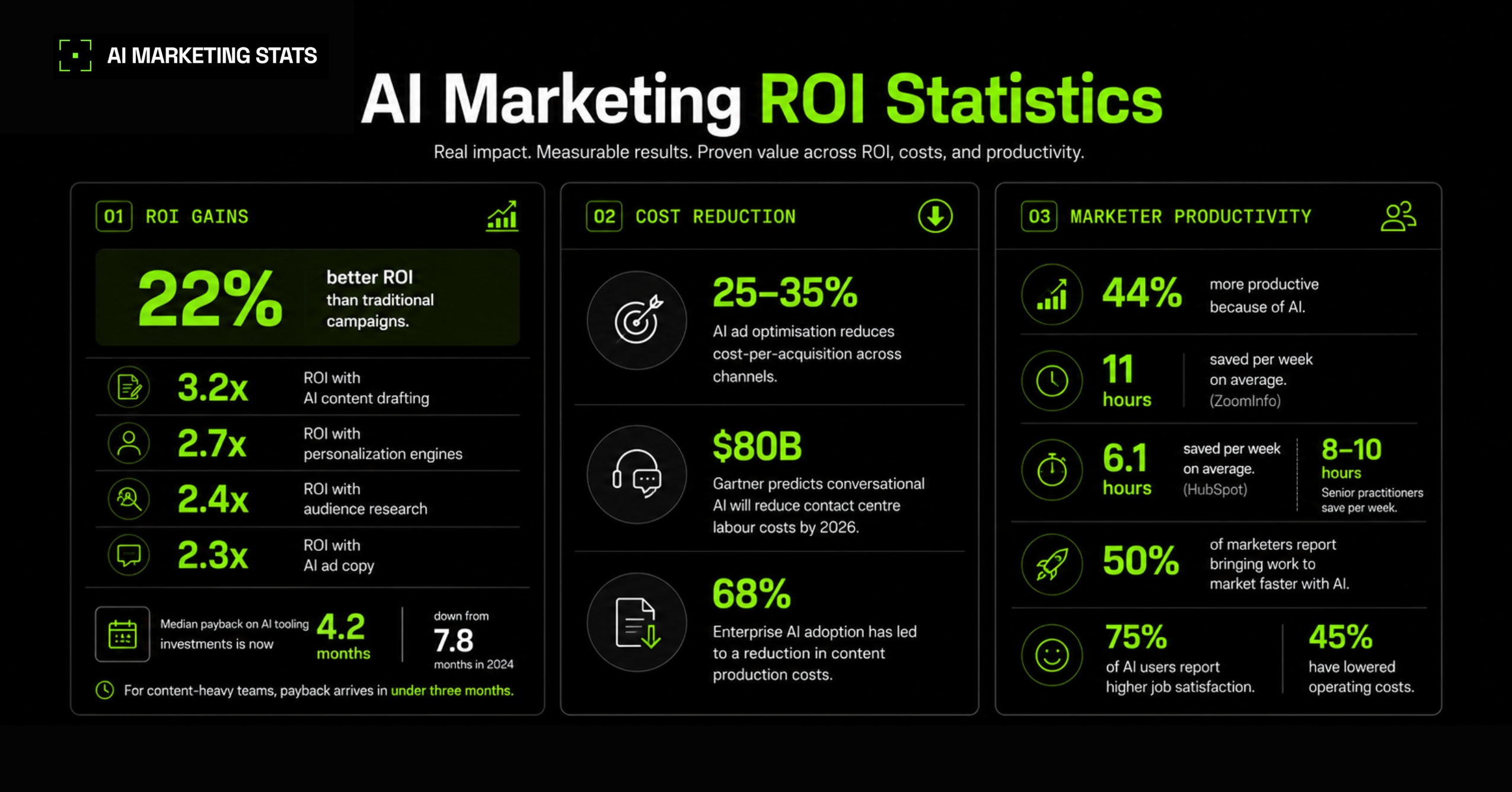
- AI-driven campaigns deliver 22% better ROI than traditional campaigns. The ROI gap grows as teams move from experimental to strategic AI use.
- AI content drafting delivers 3.2x ROI on average. Personalization engines deliver 2.7x ROI. Audience research delivers 2.4x ROI. Ad copy delivers 2.3x ROI.
- Median payback on AI tooling investments is now 4.2 months, down from 7.8 months in 2024. For content-heavy teams, payback arrives in under three months.
- 71% of marketing leaders who adopted AI tools in 2024-2025 report positive ROI within six months, versus 48% two years ago.
Sources: McKinsey, HubSpot, Digital Applied
Cost Reduction
- AI ad optimisation reduces cost-per-acquisition by 25-35% across channels.
- Gartner predicts conversational AI will reduce contact centre labour costs by $80 billion by 2026.
- Enterprise AI adoption has led to a 68% reduction in content production costs.
Sources: Gartner, AdAI News
Marketer Productivity
- Marketers are 44% more productive because of AI and save an average of 11 hours per week. (ZoomInfo)
- HubSpot reports marketers save 6.1 hours per week on average. Senior practitioners save 8 to 10 hours. (HubSpot AI Trends 2026)
- 50% of marketers report bringing work to market faster with AI. 75% of AI users report higher job satisfaction. 45% have lowered operating costs. (Jasper 2026)
“AI marketing ROI is increasingly measured through real business impact, not content volume alone.” — McKinsey Global AI Survey, 2025
Sources: HubSpot, McKinsey, ZoomInfo
Generative AI Marketing Statistics
Generative AI has crossed the tipping point from experimental tool to marketing operating system. What began as content drafting assistance has expanded into Personalization, ad creative, data analysis, and agentic campaign execution.
How Marketers Use Generative AI
- 87% of marketers use generative AI in at least one workflow in 2026, up from 51% in 2024.
- 116% year-over-year surge in generative AI adoption among marketing teams, the fastest technology adoption curve in modern marketing.
- 97% of content marketers plan to use AI to support their efforts in 2026, up from 90% in 2025 and 83% in 2024.
- 68% of marketers use AI for content creation, the top use case across all teams.
Sources: Salesforce, HubSpot, Siege Media
Pattern: Review and Quality Control
- 85% of marketers edit AI-generated content before publishing. AI generates drafts efficiently, but marketers who publish without human review consistently see lower engagement.
- 76% of teams require human editorial review before any AI-assisted content is published.
- Only 4% of marketers trust raw AI output without human oversight.
| Generative AI Use Case | Adoption | Impact |
| Content drafting | 85% | -42% draft time, 3.2x ROI |
| Ad copy generation | 64% | 2.3x ROI |
| Email Personalization | 62% | +41% revenue per send |
| Image / visual creation | 58% | Faster creative cycles |
| SEO optimisation | 48% | +19% organic traffic |
| Video creation/editing | 38% | 1.1-1.6x ROI |
Sources: AdAI News, Digital Applied
AI Personalization Statistics
AI-powered personalization has moved from a competitive advantage to a baseline expectation. Consumers now expect brands to understand their preferences, recommend relevant products, and communicate at the right time. The most effective teams treat Personalization as an editorial and strategic choice powered by first-party data and AI engines.
Personalization Impact
- Nearly 80% of business leaders say consumers spend an average of 34% more when their experience is personalized.
- AI-driven Personalization improves email click rates by 26% and conversion by 20%.
- Personalized emails generate 6x higher transaction rates than generic sends.
- AI-generated subject lines outperform human-written by 26%. Combined with send-time optimisation, the lift reaches 40%.
- Personalized landing pages convert 2.3x better than generic versions.
- Personalization engines deliver 2.7x ROI on average.
Sources: McKinsey, Braze, Adobe
Personalization Adoption
- 91% of brands worldwide use email Personalization.
- 73% of email campaigns use dynamic content blocks for real-time tailoring.
- 62% of teams use first-party data as their primary Personalization input, as third-party cookies continue phasing out.
- 61% of enterprise email programmes use AI for at least one element of campaign creation.
Sources: Litmus, Adobe, Salesforce
AI Search and Marketing Statistics
AI-powered search is fundamentally reshaping how content is discovered and consumed. Zero-click behaviour, AI Overviews, and conversational search interfaces are forcing marketers to rethink organic strategy from clicks to citations.
Zero-click Search Behaviour
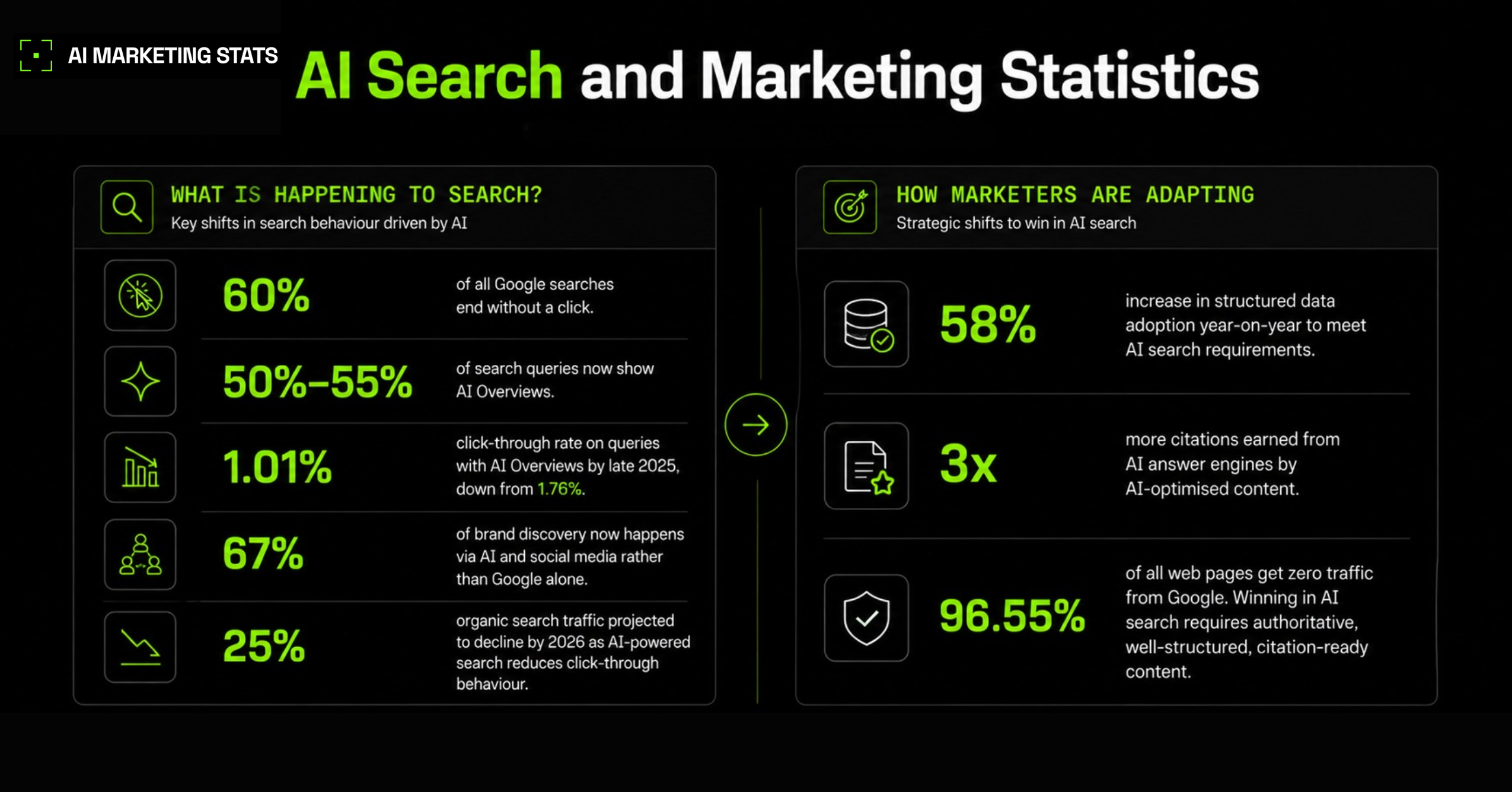
- Zero-click queries account for approximately 60% of all Google searches.
- Google AI Overviews now appear in roughly 50% to 55% of search queries.
- Click-through rates on queries with AI Overviews fell to 1.01% by late 2025, down from 1.76%.
- 67% of brand discovery now happens via AI and social media rather than Google alone.
- Gartner predicts organic search traffic will decline 25% by 2026 as AI-powered search reduces traditional click-through behaviour.
Search Strategy Shifts
- Structured data adoption has increased 58% year-on-year to meet AI search requirements.
- AI-optimised content earns 3x more citations from AI answer engines than non-optimised content.
- 96.55% of all web pages get zero traffic from Google. Winning in AI search requires authoritative, well-structured, citation-ready content.
Sources: Semrush, HubSpot
AI Chatbot and Customer-Service Statistics
AI chatbots have evolved from basic FAQ handlers into autonomous agents resolving complex issues, predicting customer needs, and driving measurable business outcomes. The technology is advancing rapidly, but consumer trust and sentiment remain a critical gap.
Adoption and Outcomes
- 80% of companies are either using or planning to adopt AI-powered chatbots for customer service.
- 88% of contact centres report using some form of AI-powered solution, yet only 25% have fully integrated automation into daily operations.
- Gartner predicts conversational AI will reduce contact centre labour costs by $80 billion by 2026.
- Gartner predicts agentic AI will autonomously resolve 80% of common customer service issues without human intervention by 2029.
- Salesforce’s internal Agentforce deployment resolved 83% of customer service queries autonomously with no human escalation.
- Over 67% of consumers worldwide have engaged with a chatbot for customer support in the past year.
Sources: Zendesk, Gartner, Salesforce, Avaya, Intercom
Chatbot Performance
| Metric | Statistic |
| Consumer preference for bots for immediate help | 51% |
| Consumers who believe bots will have natural conversations by 2026 | 56% |
| Consumers who say chatbots should match skilled human agents | 68% |
| CX leaders who believe chatbots personalise journeys | 70% |
| Users who say conversational AI resolved their issue | 63% |
| Users who find chatbots harder than humans | 53% |
Sources: Zendesk, Avaya
How Consumers Feel About AI Marketing
While marketers rush to adopt AI, consumers are sending increasingly mixed signals. Trust in AI peaked in 2023 and has since declined, creating a growing tension between business efficiency and customer experience.
Trust and Comfort
- Consumer comfort with brands using AI fell from 57% in 2023 to 46% in 2024.
- Consumer trust in AI fell to 59% in 2025, down from a peak of 62% in 2023. The share who find AI ‘very untrustworthy’ more than doubled from 5% to 12%. (Avaya 2025)
- 87% of consumers want companies to disclose when AI is used. 90% say they should always have the option to reach a human.
- 14% of consumers would lose trust in a business if they interacted with an AI agent that does not clearly explain it is AI.
Sources: Qualtrics, SurveyMonkey
Customer Service Sentiment
- 57% say their trust in a business would decrease if it predominantly uses AI for customer service, up from 53% six months earlier. (AnswerConnect 2026)
- 70% believe customer service would get worse if humans were removed in favour of AI, up from 65%. (AnswerConnect 2026)
- 73% say they would be more loyal to companies that use real people for all service interactions, up from 69%. (AnswerConnect 2026)
- Nearly three-quarters of customers say they would leave a brand that uses only AI, with no human alternative. (Avaya 2025)
- Consumers are most comfortable with AI for low-risk tasks such as scheduling appointments (60%), but only 19% trust it for banking transactions. (Avaya 2025)
“AI is not failing because of the technology. It is failing because it removes what customers value most: being understood.” – Natalie Ruiz, AnswerConnect, 2026
Sources: AnswerConnect, Avaya
The Biggest AI Marketing Challenges
What marketers say slows them down in 2026, ranked by frequency across industry surveys and practitioner research.
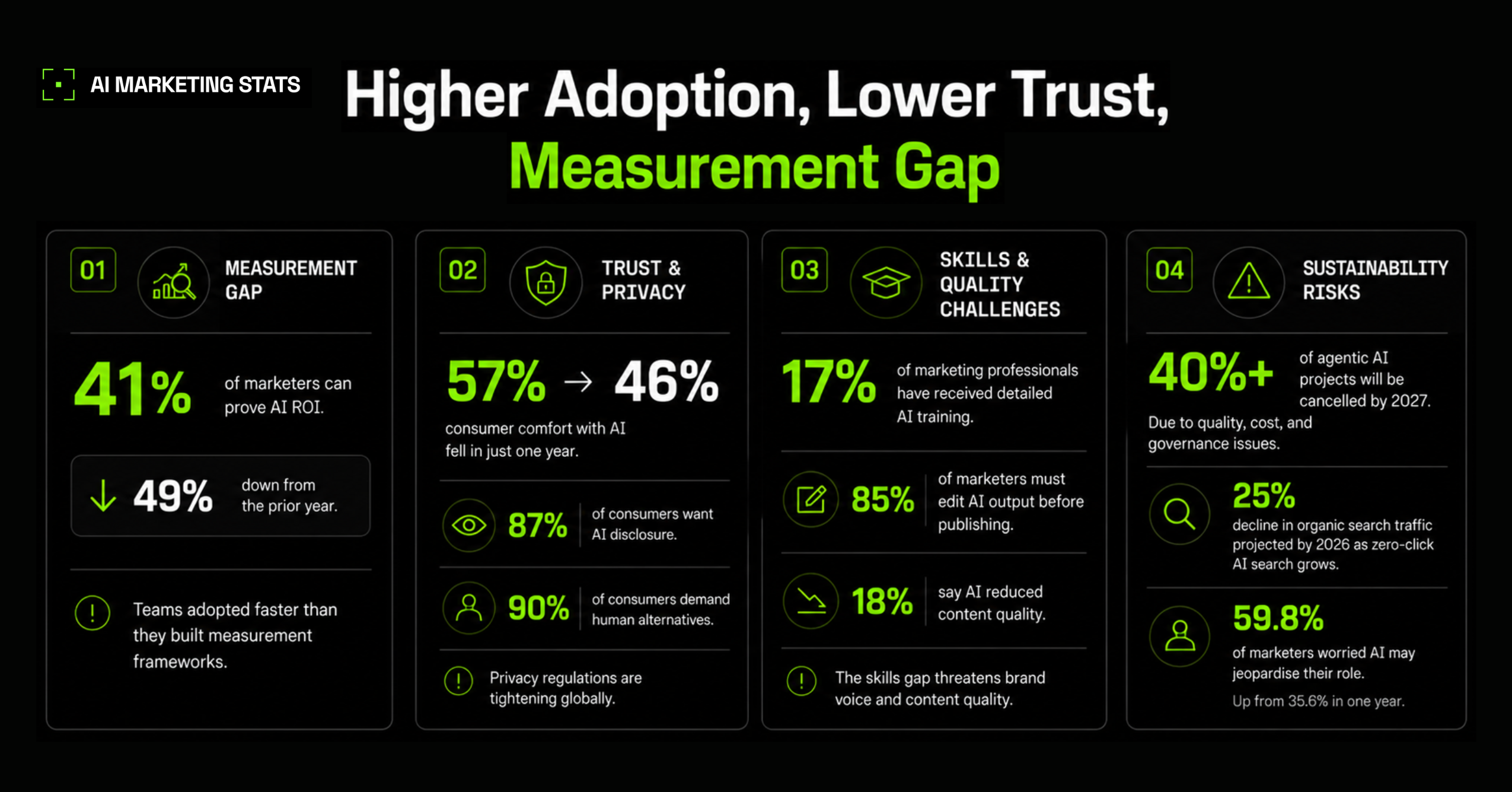
- Measuring and proving ROI: Only 41% of marketers can prove AI ROI, down from 49% the prior year. Teams adopted faster than they built measurement frameworks.
- Data privacy and compliance: 87% of consumers want AI disclosure and 90% demand human alternatives. Privacy regulations are tightening globally.
- Skills gap and training: Only 17% of marketing professionals have received detailed AI training, despite near-universal tool usage.
- Declining consumer trust: Consumer comfort with AI fell from 57% to 46% in one year. Trust erosion threatens long-term adoption gains.
- Maintaining quality and brand voice: 85% of marketers must edit AI output before publishing. 18% say AI reduced content quality.
- Agentic AI project failure: Gartner predicts 40%+ of agentic AI projects will be cancelled by 2027 due to quality, cost, and governance issues.
- Declining organic search traffic: Gartner predicts a 25% decline in organic search traffic by 2026 as zero-click AI search grows.
- Measuring productivity vs. output quality: Marketers worried AI may jeopardise their role rose from 35.6% to 59.8% in one year.
Sources: Jasper, Gartner, McKinsey, HubSpot, Qualtrics
What Is Changing in AI Marketing
AI is moving from an experimental tool to a core marketing operating system. Here are the six shifts defining the next era.
1. Agentic AI Moves to Production
19.2% of marketing teams are deploying AI agents for full end-to-end campaign automation. These are not just content generators; they are autonomous systems managing targeting, execution, and optimisation loops. Salesforce’s Agentforce resolved 83% of queries without human escalation. Customer service conversations with AI agents grew at a compound monthly rate of 2,199% between January and June 2025. (Salesforce, HubSpot 2026)
2. AI Search Rewrites Discovery
With 60% of Google searches ending without a click and AI Overviews appearing in 50-55% of queries, the playbook for organic traffic is being rewritten. Content must now be structured for citation by AI answer engines, not just ranked in a traditional SERP. (SparkToro, Gartner)
3. Personalization Becomes Real-time
AI Personalization engines now deliver 2.7x ROI, with real-time adaptive workflows boosting conversions by 26%. Automated behaviour-triggered email flows account for just 2-5% of sends but drive 30%+ of email revenue.
4. Trust Becomes a Differentiator
As AI adoption becomes universal, consumer trust in AI is declining. Brands that invest in transparency, human alternatives, and genuine value creation through AI will outperform those that prioritise efficiency at the expense of customer experience. 73% of consumers reward companies with real-human service with greater loyalty.
5. Budget Shifts from Headcount to Tooling
AI spending has surged to represent 9% of total marketing budgets, up from 7% in 2024, even as overall marketing budgets remain flat at 7.7% of revenue. Teams are reallocating resources, not expanding them. CMOs plan to allocate 28% of martech budget to AI tools in 2026.
6. Governance Becomes Mandatory
With 40%+ of agentic AI projects predicted to fail, governance is shifting from optional to essential. 76% of teams require human editorial review. Only 41% can measure ROI. The organisations that build measurement and governance into their AI programmes from day one are the ones capturing the 10-20% sales ROI gains.
Sources: Salesforce, McKinsey, Gartner, HubSpot, World Economic Forum, Qualtrics, AnswerConnect
Methodology
To ensure accuracy, every statistic in this report was verified against its original publication rather than secondary citations. We reviewed research published between 2024 and 2026 from leading technology companies, consulting firms, research organizations, government agencies, and industry surveys.
Our editorial process includes:
- 120+ authoritative sources reviewed, including HubSpot, IBM, Salesforce, Gartner, McKinsey, Grand View Research, Statista, Adobe, Qualtrics, Zendesk, and other primary research organizations.
- Every statistic is cross-checked with its original source to confirm methodology, publication date, and context.
- Where multiple market forecasts exist, we cite the most widely referenced estimates and clearly note differences in forecasting methodologies.
- The report covers global AI marketing adoption, market size, ROI, generative AI, personalization, AI search, chatbots, consumer sentiment, and emerging industry trends.
- Statistics are reviewed and updated monthly to reflect the latest available data and remove outdated figures.
- AI Marketing Adoption Statistics
- AI Marketing Market Size Statistics
- AI Marketing ROI Statistics
- Generative AI Marketing Statistics
- AI Personalization Statistics
- AI Search and Marketing Statistics
- AI Chatbot and Customer-Service Statistics
- How Consumers Feel About AI Marketing
- The Biggest AI Marketing Challenges
- What Is Changing in AI Marketing
- Methodology